Monday, April 22, 2019

Colorado Tartan Day, Celebrating Scottish Independence and the Declaration of Arbroath

From April 6th 2019: good memories and a bit of good history.
(don't miss the Medieval Covid masks)

     Shared a wonderful day with my sister at the Boulder County Fairgrounds during the Tartan Day festival. Here is the Colorado state tartan!
  There were several tents set up creating a Scottish
village offering sights and sounds begging us to explore and experience all things Scottish. 
  
We discovered armor, antique weaponry, demonstrations of spinning (this nice lady explained the drop-spindle which I have yet to master) beautiful
clothing, and books on clan history. And all the while we listened to amazing Highland Rock and Roll performed by the Angus Mohr group bought these two CD's         

Angus Mohr website
                                     
A wonderful display or armaments and armor. 

Clothes for the romantic at heart.

          There was a blacksmith demonstration, 

    A rare glimpse of a Faerie, as well as numerous Scottie dogs, some wearing kilts. 
For Steampunk lovers there was a leather helm fashioned after the headgear worn by physicians in the middle ages during the plague years.  Who knew by 2020 we'd all want one!
                                              
Above items created by Michael Trent 

About Tartan Day 
Originating in Canada in the mid-1980's, Tartan Day is a North American Scottish heritage celebration of Scottish Independence. Held in the Spring, the gathering commemorates the April 6th, 1320 signing of the Declaration of Arbroath.
                
   Submitted on that date, in Latin, to Pope John XXII, the intention was to confirm Scotland's status as an independent, sovereign state, while defending Scotland's right to use military action when unjustly attacked.
     
    Believed to have been written in the Arbroath Abbey by Bernard of Kilwinning, Chancellor of Scotland and Abbot of Arbroath, the letter is the sole survivor of three created at the time. 
                            
                                            Arbroath Abbey
     The others were a letter from the King of Scots, Robert I, and a letter from four Scottish bishops which all presumably made similar points.                                               
 Steeped in turmoil and political intrigue the declaration was part of a broader campaign for independence from England's Norman kings and a plea to lift the excommunication of Robert The Bruce.
  
    Here are the most famous lines from the English language translation by Sir James Fergusson, Keeper of the Records of Scotland. 
  ...for, as long as but a hundred of us remain alive, never will we on any conditions be brought under English rule. It is in truth not for glory, nor riches, nor honours that we are fighting, but for freedom – for that alone, which no honest man gives up but with life itself.
             
               Woot woot thanks for stopping by. 


Tuesday, April 9, 2019

The Bayeux Tapestry

                To the Victor go the Spoils,
                  Image result for images bayeux tapestry
 and the opportunity to record history from their point of view. The amazing Bayeux Tapestry is just such an example.                         Image result for images the bayeux tapestry
 For many years, I have been captivated by the beauty, artistry and mystery of the Bayeux Tapestry, and recently have begun reproducing a tiny portion of this historical treasure. 
 

      Thanks to Youtube, I watched instructions (from Bayeux, France!) showing the two main stitches used throughout the tapestry. One of them is actually known as the Bayeux stitch. 
              Image result for image bayeux tapestry length
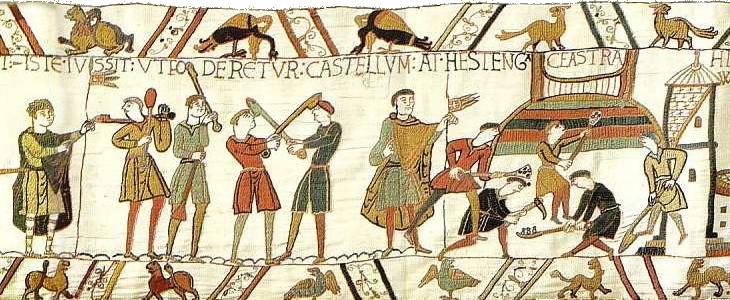
  Almost 1,000 years old, the Tapestry is more than 70 meters long (that's over 230 feet). It depicts one of the most pivotal moments in British history--the Norman Conquest of 1066, particularly the battle of Hastings which took place October 14 of that year.
             Image result for image site of the battle of hastings
                     Field where the battle took place.
     Not really a tapestry, but wool embroidered on linen cloth, the extraordinary undertaking is composed of several panels worked separately and then sewn together. 
Image result for images bayeux tapestry chain mail
                       chain-mail and supplies being taken to the ships.
Besides historical information about the political climate and the final battle, there are numerous insights into the style and fashion of Anglo-Saxon and Norman clothing, medieval ship-building, sailing, carpentry, and even battle techniques and what type of chain-mail was used.
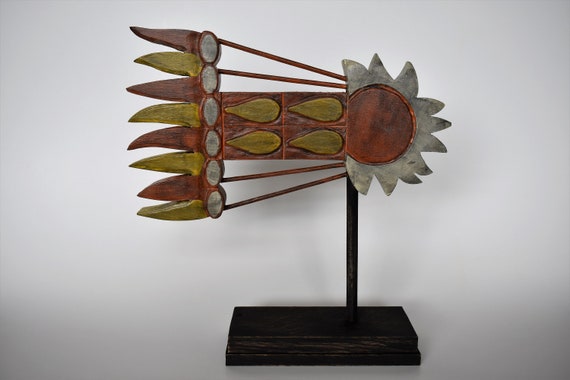
       The story also chronicles a cosmic event.
                   
                              see comet, upper right hand side.
When Edward the Confessor dies, the nobles declare Harold the new king. Harold ignores his prior oath to  William, and the fight is on. A hoary star (Halley's comet) shoots across the sky signaling a bad omen for Harold.                                          
A metal replica of the comet in the tapestry. Might need this.
        We also learn William brought horses across the channel from Normandy. Quite a difficult, and  unexpected achievement.
                Image result for images horses in boats in bayeux tapestry
                              see the little horses peeking out of the boat!
Harold Godwinson is, of course, defeated at Hastings, and the "arrow in the eye" legend is validated. But the ending is abrupt and many people speculate the final frames are missing as there is no reference to Williams coronation.                     Image result for images arrow in harold's eye in bayeux tapestry   
       Who commissioned and made the tapestry?
A majority of historians agree the most likely patron was Odo, the half-brother of Duke William, and the bishop of Bayeux.
 Image result for image odo bishop of BayeuxWilliam and his half-brothers Odo Bishop of Bayeux and Robert of Mortain in the Bayeux Tapestry. By special permission of the City of Bayeux. Detail of the Bayeux Tapestry, 11th century
                                He is seen several times in the tapestry.
For a long time William the Conqueror's wife, Queen Matilda was thought to have initiated the project. This view is now out of favor. It may even have been made on the orders of William himself. The mystery continues.
                  Image result for images bayeux tapestry text
     The Latin inscriptions use Old English letter forms, as found in Anglo-Saxon illuminated manuscripts. Some similar designs were discovered in manuscripts at a monastery in Canterbury. Was it made there?
       
        Whoever came up with the idea, the design and embroidery work was most likely done in England, by English hands. How cruel for the conquered to find themselves working to glorify the new king, the usurper.
                What was it's purpose?
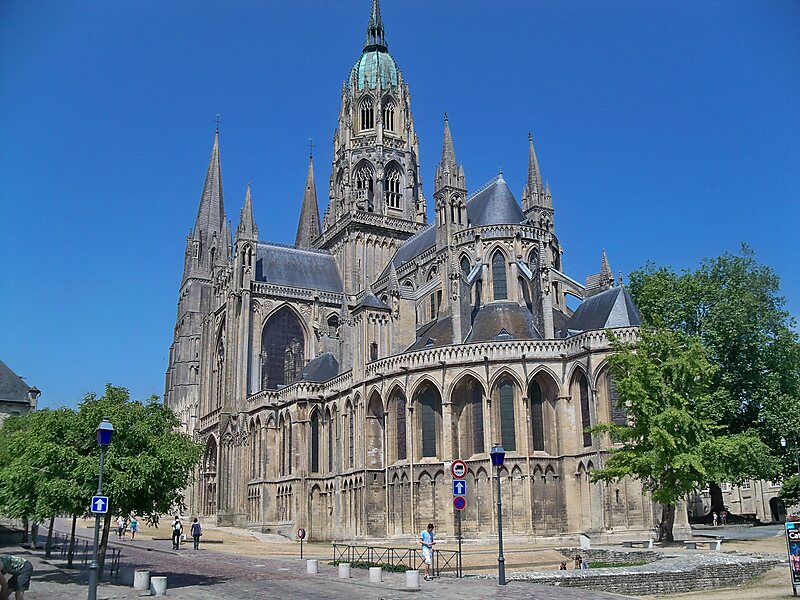
The huge tapestry may have been on display at first, and then stored and seen only on special occasions. It may have graced the new cathedral Odo built in 1077 in Bayeux. From at least 1476 onward, the tapestry was detailed in the cathedral inventory.Image result for images bayeux cathedral

Image result for images of bayeux cathedral with tapestry
In the 19th century, Napoleon had it brought to Paris for display as he made plans to invade Britain. In the Second World War the Nazis found it a useful tool (found this to be both odd and curious).

The Bayeux Tapestry has it's share of mysteries, and  I will daydream of all the possibilities as I work on my tiny scrap of history. The story of its creation must hold the makings of a good book---working on that too. 


Monday, March 18, 2019

Soda Bread BEFORE baking soda and the Arm and Hammer revolution.


Did you enjoy a great loaf of Irish Soda Bread on St. Patrick's Day?

What did they use before baking soda was invented?

Native Americans knew the secret of soda ash, used in their baking, and potash and pearlash was used in the 17th and 18th centuries by Colonists adding a distinctive flavor to baked goods. 
Potash starts with lye, produced by passing water through hardwood ashes. Evaporating the lye water leaves behind the solid potash. Pearlash is refined potash derived by baking it in a kiln to remove impurities. 


In 1796, Potash shows up as an ingredient in recipes in the first American cookbook American Cookery.   


 1843: Alfred Bird, a British chemist, makes the first version of baking powder to help out his wife, who was allergic to yeast.
Working with this theory,  in 1846 brothers-in-law Dr. Austin Church and John Dwight began preparing bicarbonate of soda for commercial distribution. They packaged their product by hand in paper bags in Mr. Dwight's kitchen. This product was easier to use as it did not require two ingredients mixed at time of cooking as did baking powder. 
Over the years, the company went through many changes in company mergers and in advertising.   
They started out with the Cow brand, before settling on the now iconic Arm & Hammer symbol. In 1860's they mailed out recipes and suggestion for use. 1880's they offered "beautiful birds of America" trading cards. And in 1907, way ahead of the curve, they began using recycle material for packaging. 
In 1922 they published  "A Friend in Need" health education booklet, touting it as a "proven medicinal agent." good for bathing and cleaning teeth. 


There seemed no end to the Company's advertising genius. In 1950's they came up with the reference "wheel" which shows consumers how to utilize Baking Soda's versatility around the home. And 1970's  the first nationally-distributed, phosphate-free detergent, and a new way to keep your refrigerator fresh.
       
                     Image result for images first earth day

     They also sponsor the first Earth Day! in 1970.

 Today baking soda is found in many products from toothpaste to cat litter. Sometimes the old ways are the best ways. 


Thursday, March 14, 2019

Belgian Sea Horses!

                Love to fish, love to ride horses?
           Do both at the same time, and end up
                 with a wonderful shrimp dinner.

This is not a new idea but rather a very old one, practiced for centuries by the fishermen of  Oostduinkerke, in West Flanders, Belgium
Image result for belgium fishing on horses

 The horses used are Brabant horses, a regional breed that is large and sturdy (generally around 5’7”, or 16 hands, at the withers), with dense feathering on their lower legs.

      Choosing the right horse is a crucial part of the equation," D’Hulster told the Times. “The first time a horse sees the sea and the waves, you can see it running back. They don’t like it.” 
                           Image result for belgium fishing on horses
   But the right horse is a lifelong companion. “There is such a love story between the horse and the fisherman,”
                     
   Behind them, a 30-foot funnel-shaped net stretches back into the waves. As the horse walks, a chain dragged over the sand creates vibrations—causing the shrimp to jump into the net. 
   Slowly, they go to and fro, walking the length of the flat coastline, as the net fills with shrimp. Once every half hour, they return to the beach: The horse has a few moments to rest as the fisherman empties the net, using wooden sieves to sift through the catch.
                  
Jellyfish, small fish, and other unwanted sea life are jettisoned back into the ocean, while the shrimp are placed into vast baskets dangling by the horse’s sides. Once they have enough, perhaps 20 or 30 pounds of shrimp, they will return home,
                Image result for belgium fishing on horses

Successful fishermen must have discipline and a deep love for the sea, their horse, and their heritage. 

For more details read Natasha Frost's article


Monday, February 11, 2019

Longmont Library Author Festival 2019


What a wonderful day being pampered and made to feel so special at the Longmont Library. 


It was beautiful weather, and I met lots of readers and other authors, and shared some quality time with my sister. 


                              Image may contain: 3 people, people smiling, people sitting
              My "table buddy" was Betty Lavelle:                                 photographer, artist, and poet. 

      Thank you Sherri, and all the wonderful people at the Longmont Library for once again making the author appreciation festival a great event.  


Image result for Muskoka Falls
For a peek at Ontario history, don't miss Patricia Stott-Prince's book Muskoka Falls: The Village 1859 – 2018

   Patricia grew up in Muskoka Falls, and felt there was a need to record the history of the village which she loves. Her father William McClelland, built the Muskoka General Store in 1947, and the family lived at the store, which is still standing as a private home. A big part of the community, McClelland also ran the Highland Mill. 
Patricia Stott-Prince
Patricia's writing adventure sent her researching long forgotten archives, and offered her an opportunity for re-acquainting and reminiscing with old friends. 

For a signed copy Muskoka Falls: The Village 1859 – 2018  go to...stottprince@gmail.com.

 For folks in the area, stop by...... Veranda in Bracebridge and the Muskoka Discovery Centre in Gravenhurst. 


Snow Sculpting in Berthoud

Sunday, January 27, 2019

Remembering a piece of Ontario history.

For a peek at Ontario history, don't miss Patricia Stott-Prince's book Muskoka Falls: The Village 1859 – 2018

  Patricia grew up in Muskoka Falls, and felt there was a need to record the history of the village which she loves. Her father William McClelland, built the Muskoka General Store in 1947, and the family lived at the store which is still standing as a private home. A big part of the community, McClelland also ran the Highland Mill. With the Ontario Free Grants and Homestead Act (1868), land was opened to settlement in the Muskoka area and became available to farmers.

Patricia Stott-Prince

Patricia's writing adventure sent her researching long forgotten archives, and offered her an opportunity for re-acquainting and reminiscing with old friends. 

The Muskoka region is named for the Ojibwe chief who resided there, Mesqua Ukie / Mesqua Ukee (whose name is said to mean "not easily turned back in the day of battle").

Patricia never turned back either, and her finished book is now available.

For a signed copy of
 Muskoka Falls: The Village 1859 – 2018  
go to...stottprince@gmail.com.

 For folks in the area, stop by...... Veranda in Bracebridge and the Muskoka Discovery Centre in Gravenhurst.